Solar eclipse 2026: how to watch it without burning your retina (for real)
1 August 2026 · 5 min read
What will we see from Cardedeu and Barcelona?
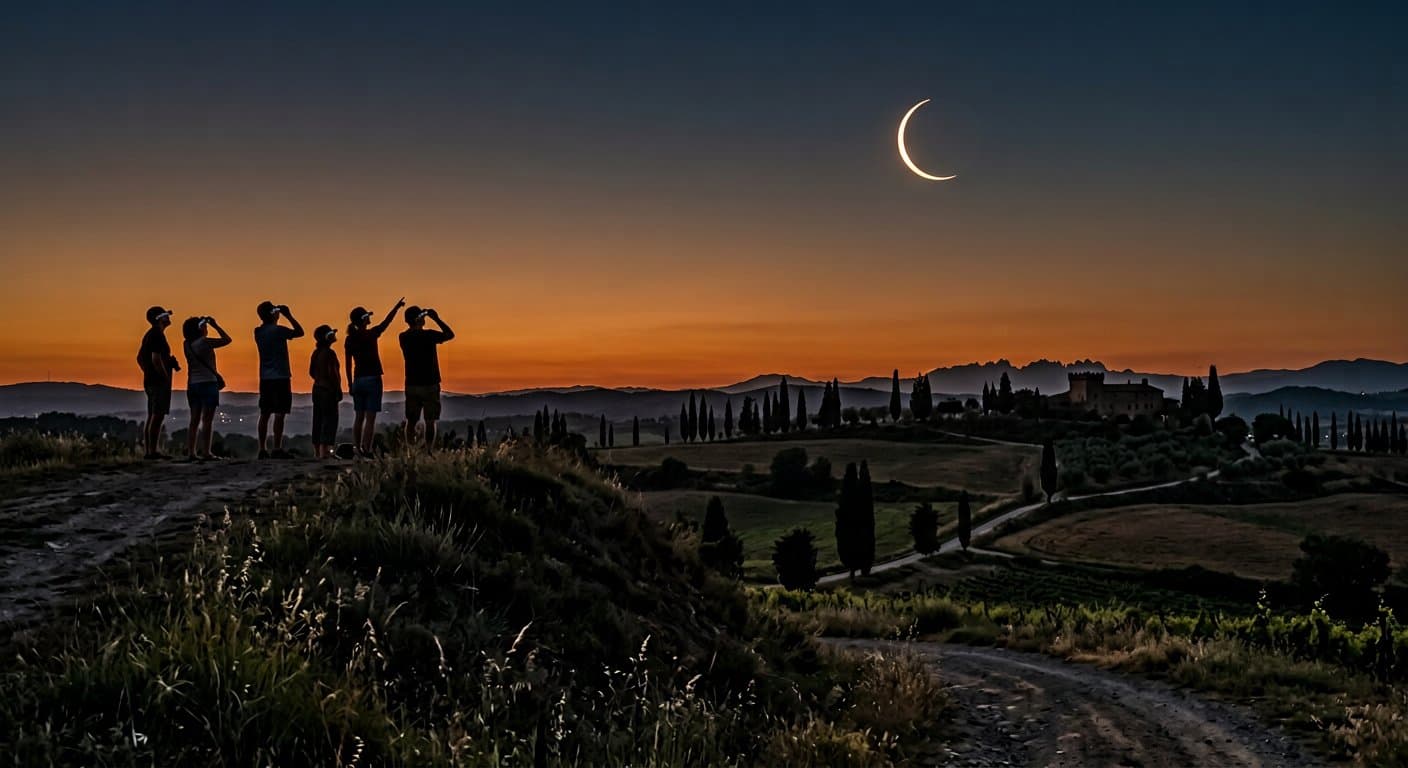
On Wednesday 12 August 2026 the Moon will cover the Sun in a way nobody alive has seen from Spain: the first total solar eclipse over the country in more than a century. From Barcelona and Cardedeu we are just outside the path of totality, but the partial eclipse reaches about 99.7-99.8% coverage: the Sun will shrink to a razor-thin crescent and the daylight will dim dramatically.
The tricky part is the timing. The partial phase starts around 19:34 (20:29 maximum) with the Sun very low over the western horizon, barely 4 degrees high, and the Sun sets around 20:55 while still eclipsed. You need a clear west view: open countryside, a hill, the sea. Totality itself crosses Galicia, the Basque Country, Zaragoza, Castellón and Mallorca — and, closer to us, Tarragona and southern Lleida, where day will turn to night for over a minute.
- Start of partial phase: ~19:34-19:35 (Barcelona), ~19:40 (Girona).
- Maximum: 20:28-20:29, Sun ~4° high in the west.
- Sunset: ~20:55, still eclipsed. End (not visible, below horizon): ~21:20.
The danger nobody feels
The retina has no pain receptors. You can burn it looking at the Sun for tens of seconds and notice nothing at the time; hours later a blurred or dark spot appears in the centre of your vision — solar retinopathy — and that damage can be permanent. Surveys after past eclipses always find people who «just peeked for a second».
During an eclipse two traps combine: the Sun is so dimmed it feels comfortable to stare at (your instincts lie), and everyone is looking up for a long time. Never trust sunglasses, smoked glass, CDs, film negatives, stacked filters or camera viewfinders. Binoculars or a telescope without a proper aperture filter will concentrate the light and can destroy a retina in under a second.
How to watch it safely
- Certified eclipse glasses meeting ISO 12312-2 (and the CE mark), bought from an optician or an astronomy supplier — never from a street stall. Check for scratches or pinholes: if damaged, bin them.
- Put the glasses on BEFORE looking up, and keep them on until you look away. Every single time.
- Children: supervised the whole time, glasses checked for a snug fit, and explained in advance that peeking around the glasses is forbidden.
- Safe DIY option: pinhole projection — a small hole in a card projecting the crescent Sun onto paper. The full spectacle, zero risk, and great with kids.
- If you wear prescription glasses, keep them on and put the eclipse glasses on top.
And the day after?
If in the hours after the eclipse you notice blurred central vision, a grey or dark spot, distorted straight lines or unusual light sensitivity, book an eye exam quickly and mention the eclipse. Most cases improve over months, but early documentation matters.
At the optician's we can advise you on certified ISO 12312-2 eclipse glasses and the best viewing spots around Cardedeu. One heads-up: we close for holidays 8–16 August, so if you want last-minute advice, come before the 8th. And remember: certified glasses sell out everywhere in the final week of every eclipse — this one won't be different.