How myopia began: from Aristotle to today's epidemic
18 July 2026 · 7 min read
If you see blurry at a distance, you're part of a very old club. Around 350 BC, Aristotle wrote down a not-at-all modern but perfectly recognisable profile: people who half-closed their eyes to make out distant objects. The Greeks called them myops — from myein (to close) and ops (eye), 'those who look with squinted eyes'. That's exactly where the word myopia comes from.
For centuries it remained a minority complaint, almost a profession: scribes, philosophers, embroiderers and goldsmiths — people who lived with their noses nearly touching the page. In the fields, at sea or at war, good distance vision was a matter of survival, and myopia was far from common.
Glasses came first… but not for myopes
The first documented glasses appear around 1286, probably in Pisa, and they weren't for myopes: they were convex lenses, bulging, designed for the tired near vision of the era's great readers. This detail surprises people today: optics began by fixing near vision, not distance vision.
Concave lenses — the ones that correct myopia — took another couple of centuries. The philosopher Nicholas of Cusa describes them around 1451, cut from beryl, and by the 16th century they were common among European scholars. Pope Leo X, a distinguished myope, used a concave lens when hunting: probably the first 'sporty' user in the history of optics.
1604: Kepler finds the eye's secret
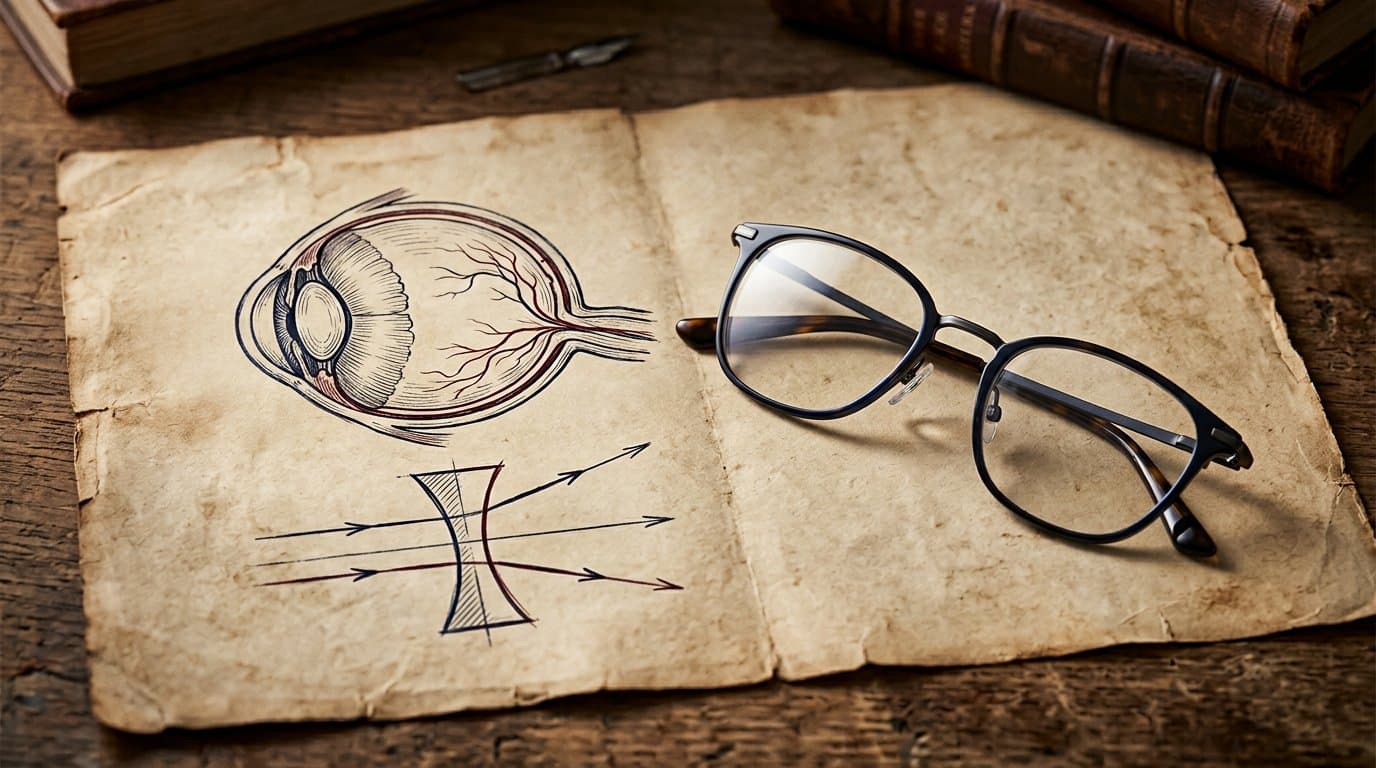
The scientific leap comes with astronomer Johannes Kepler, who in 1604 explains for the first time how the eye works: light enters through the pupil, the internal lenses focus it and the image is projected sharply onto the retina, as in a camera obscura. Everything follows from there: myopia is, quite simply, an eye that focuses the image in front of the retina instead of exactly on it.
In 1864, the Dutch physician Franciscus Donders scientifically organised the 'refractive errors' — myopia, hyperopia, astigmatism — and laid the foundations of the modern eye exam, the same one we perform today in our Cardedeu consulting room.
From rarity to epidemic: the century that changed everything
Until well into the 20th century, myopia affected a minority of the population. Three waves turned it into a global epidemic: mass schooling (whole years of reading and near work), indoor living (less natural light, more four walls) and, since 2007, pocket screens.
The extreme case is East and Southeast Asia: in cities in South Korea, Taiwan, Singapore or urban China, between 80% and 96% of young adults are already myopic. Europe and North America sit between 40% and 50% of young people. And Western Europe — Spain included — is growing fast, especially at school age.
The evolution in figures: heading for a half-myopic planet by 2050
The reference study is the one by Holden and collaborators (2016, Ophthalmology journal and Brien Holden Vision Institute): it cross-referenced hundreds of studies from around the world and projected the evolution to 2050. The result made headlines — rightly so: from 1,406 million myopes in 2000 (22.9% of humanity) to around 4,800 million by 2050, practically half the planet.
And the most serious part is not the quantity but the intensity: high myopia is also skyrocketing, and that's the one carrying real risk of glaucoma, retinal detachment and macular degeneration. It's the big difference between 'wearing glasses' and 'having an eye-health problem'.
This interactive chart summarises the study; tap the points to see the exact figures:
Myopia worldwide: evolution and projection
% of world population with myopia (solid line: data; dashed: projection)
Where is it most common? (young people, approx.)
Estimated prevalence in young populations by region
- South Korea96%
- Hong Kong87%
- Taiwan85%
- Singapore82%
- Urban China80%
- Japan62%
- Europe45%
- North America42%
- World average34%
Why now? The school playground has a lot to say
Science is fairly clear on the mechanism: the eye grows according to the light it receives. Natural light — even in the shade, on a grey day — is thousands of lux more intense than any well-lit living room, and it stimulates dopamine in the retina, which slows excessive growth of the eyeball. Translation: playing outside is protection, literally.
- Few hours outdoors: less retinal dopamine, the eye grows more than it should.
- Lots of continuous near work: phone, tablet and long readings without breaks.
- The lockdown generation: several studies detected a jump in childhood myopia among children who spent 2020 shut indoors with screens.
And what does this mean for us?
That myopia is not only genetic, nor a 'minor ill': it's a public-health fact that can be slowed if we act early. The tools are simple — two hours outdoors a day, visual breaks every twenty minutes, good lighting — and they work best the earlier they're adopted. And if myopia is already here, today we have control-specific lens designs and contact lenses to slow its progression in children and teenagers: prescribing is not the same as controlling.